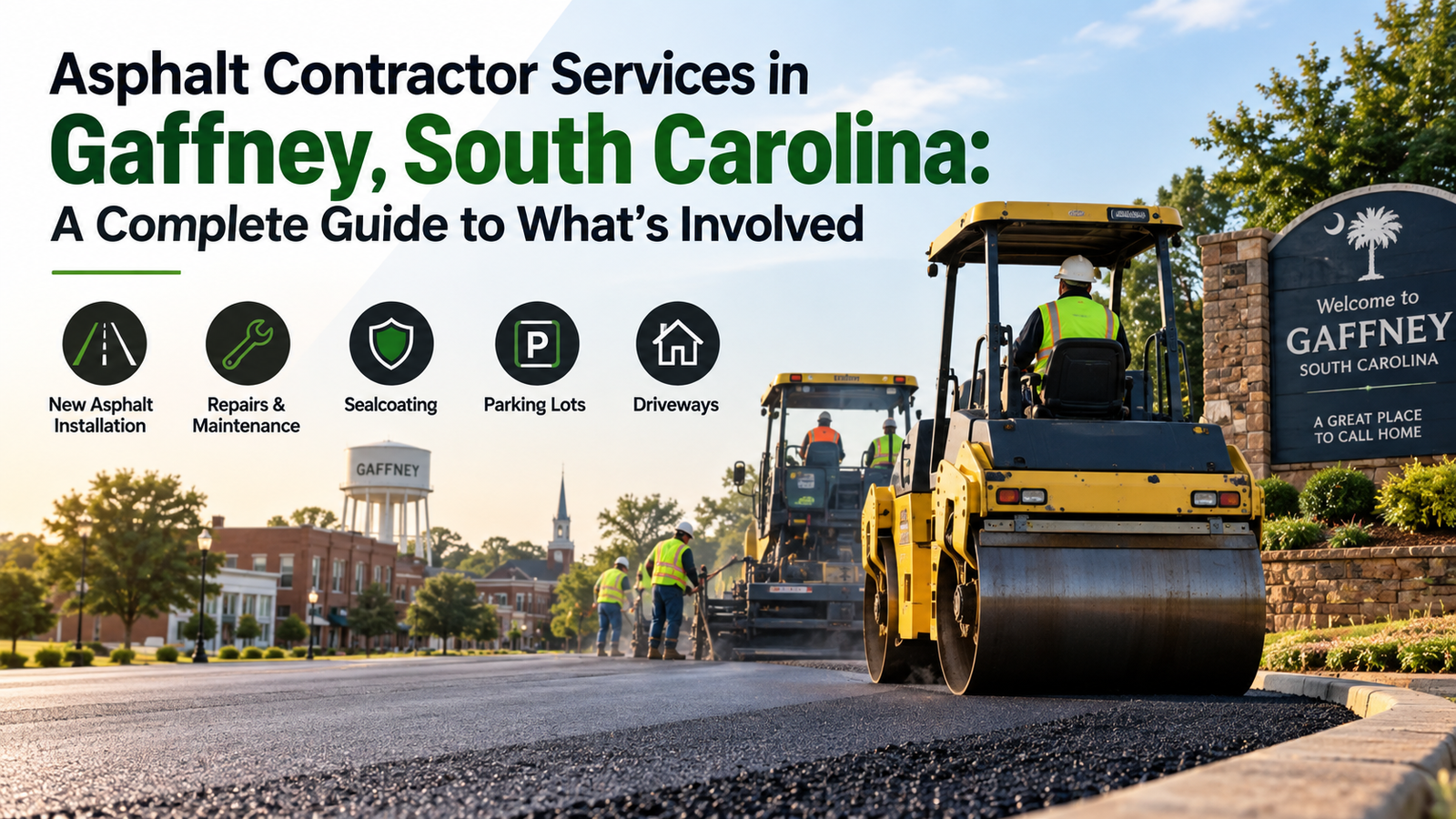
When property owners in Gaffney and Cherokee County think about Asphalt Contractor Gaffney services, they often think primarily about the moment the paving crew arrives and the new black surface appears the visible, finished product of the paving process. But professional asphalt contracting encompasses a far broader and deeper set of services than the installation itself, covering everything from the subsurface engineering of the aggregate base through the decade-long maintenance program that determines whether an asphalt surface reaches its designed lifespan or fails prematurely. This guide explains the complete scope of asphalt contractor services available in the Gaffney market, what makes each service type distinct, and how Upstate South Carolina’s specific climate and soil conditions shape the approach that quality asphalt contractors bring to every project.
New Asphalt Installation: What Happens Below the Surface
The performance of any asphalt surface is determined primarily by what happens beneath it the preparation of the subgrade and the installation of the aggregate base that the asphalt surface rests on. In Cherokee County, this subsurface preparation must account for the red clay that dominates the native soil throughout the Gaffney area. Red clay is dense, nearly impermeable, and highly susceptible to losing load-bearing capacity when saturated. A pavement structure built over unprepared clay subgrade, or over insufficient aggregate base depth, will fail dramatically faster than one with proper subgrade assessment and base preparation.
Subgrade preparation begins with stripping organic topsoil and any material that is soft, wet, or unstable. The exposed subgrade is compacted and tested, and any areas of soft or unsuitable material are either removed and replaced with suitable fill or stabilized. In Gaffney’s clay soil environment, lime stabilization mixing hydrated lime into the top layer of clay subgrade to chemically improve its load-bearing capacity and moisture resistance is sometimes used for commercial and industrial applications where the subgrade needs to be improved without complete removal and replacement.
Aggregate base installation places crushed stone over the prepared subgrade to the specified depth. For residential driveways in Cherokee County, a base of 4 to 6 inches of compacted dense-graded aggregate base stone (often called ABC stone Aggregate Base Course) is typical. For commercial parking lots and industrial applications, heavier base sections of 8 to 12 or more inches are specified based on the anticipated vehicle loading. The base material is placed in layers (lifts) and compacted with vibratory rollers to achieve the specified density under-compacted base material will settle under load, causing the asphalt above it to crack and deform.
Asphalt placement follows completed base preparation. Hot mix asphalt is delivered from a plant at temperatures between 275 and 325 degrees Fahrenheit and placed by a paving machine that spreads it at consistent depth and grade. For Gaffney’s hot summer climate, mix designs are typically specified with polymer-modified binders that maintain higher stiffness at elevated temperatures resisting the rutting that can occur when standard binder grades soften on hot Upstate South Carolina afternoons. After placement, the asphalt is compacted with steel drum rollers to achieve the specified density, creating the smooth, stable surface that characterizes quality new asphalt installation.
Asphalt Resurfacing and Mill-and-Overlay
When an existing asphalt surface has deteriorated beyond effective maintenance but the underlying base remains structurally sound, resurfacing applying a new asphalt layer over the existing surface is the most cost-effective rehabilitation approach. Mill-and-overlay is the superior resurfacing method: a milling machine grinds the existing surface to a consistent depth (typically 1.5 to 2 inches), creating a clean, textured bonding surface for the new overlay while maintaining grade relationships at curbs, garage thresholds, and drainage inlets. The milled material (reclaimed asphalt pavement, or RAP) is hauled to asphalt plants where it is recycled into new mixes.
The critical diagnostic question before recommending resurfacing is whether the existing base is sound. If the base has been compromised visible as alligator cracking (the interconnected polygon-pattern that signals base failure), soft or spongy areas underfoot, or significant depression and rutting throughout the lot resurfacing will replicate the failure within a few years because the problem is structural, below the surface that the overlay addresses. Resurfacing is the right call when surface distress is driven by UV oxidation, thermal cracking, or minor surface deterioration over a base that remains firm, well-draining, and structurally competent.
Asphalt Maintenance Services
Sealcoating is the single most impactful ongoing maintenance service for asphalt surfaces in the Gaffney climate. The Upstate South Carolina sun drives binder oxidation year-round, progressively hardening the asphalt surface from its initial flexible black state to a gray, brittle surface that cracks under thermal cycling. A quality sealcoat applied as a two-coat system with adequate cure time between coats fills the micro-voids at the asphalt surface that allow water infiltration, reflects UV radiation before it reaches the binder, and provides a petroleum-resistant barrier against fuel and oil spills that chemically attack exposed binder. The visual result (a uniformly dark, refreshed surface) is the secondary benefit; the structural protection is primary.
Crack sealing with hot-pour rubberized sealant closes the water entry pathways that are the enabling mechanism for both freeze-thaw damage and base saturation in Cherokee County. Hot-pour crack sealant is heated to 375 to 400 degrees and applied to the cleaned crack, where it flows into the crack void, bonds to the crack walls, and cures to a flexible, water-resistant seal that accommodates thermal movement of the pavement without breaking. This flexibility is what distinguishes professional hot-pour crack sealing from the cold-pour crack fillers available at hardware stores, which are rigid, achieve poor adhesion, and typically fail within one to two seasons in the Upstate South Carolina climate.
Pothole repair using full-depth methods saw-cutting the perimeter, removing all failed material down to solid base, inspecting and repairing the base if needed, applying tack coat, and placing compacted hot mix asphalt flush with the surrounding surface produces durable repairs that last years rather than months. Temporary cold-patch pothole repair, which places unheated mix into the void without proper preparation, typically survives one to two seasons in Gaffney’s conditions before failing and requiring retreatment.
Parking lot striping applies the traffic management markings that organize vehicle movement, designate accessible parking, and meet ADA compliance requirements. Striping is performed after sealcoating (with appropriate cure time) and independently as markings fade. South Carolina’s ADA accessibility standards for parking facilities require properly configured accessible spaces with correct dimensions, cross-slope, and marking striping service that updates these markings to current standards protects Cherokee County commercial property owners from liability exposure.
Commercial vs. Residential Asphalt Services in Gaffney
The asphalt contractor services required for a residential driveway in Gaffney differ from those for a commercial parking lot in specification, scale, and regulatory complexity. Residential driveways are designed for passenger vehicle loading, are typically 1,000 to 3,000 square feet in area, and have straightforward regulatory requirements no ADA compliance, no stormwater management plan, no commercial weight vehicle loading to design for. The homeowner’s primary concerns are durability, aesthetics, and proper drainage away from the house foundation.
Commercial parking lots must satisfy SCDOT standards and local zoning requirements for drainage, ADA accessibility, and in some cases stormwater management. They are designed for the mix of vehicle types that use the property including delivery trucks, service vehicles, and heavy equipment in many commercial applications and must accommodate the turning radii and traffic patterns of commercial operation. Striping, accessible parking configuration, and fire lane designation are all regulatory requirements for commercial lots in Gaffney and Cherokee County.
Industrial paving in the Gaffney corridor must be engineered for the specific loading conditions of the facility. A manufacturing plant or distribution center with constant heavy truck traffic requires pavement sections three to four times thicker than a typical commercial parking lot, polymer-modified asphalt binders for rut resistance, reinforced base construction, and design attention to the specific failure modes of heavy industrial pavement particularly at loading dock aprons, dumpster pads, and areas where tractors make tight turning movements.
Common Questions About Asphalt Contractor Services in Gaffney
Can I see the asphalt mix specification before my project begins? Yes. A professional asphalt contractor serving the Gaffney market should be able to tell you specifically what mix design (binder grade, aggregate gradation, RAP percentage if applicable) is being used for your project. For summer installations in Cherokee County, polymer-modified binder specifically PG 76-22 or PG 82-22 depending on the application provides better rut resistance than standard PG 64-22 in Gaffney’s high-temperature summer conditions.
How do I know if my Gaffney driveway or parking lot needs resurfacing or full replacement? The key diagnostic question is whether the existing base is sound. Walk the surface and look for alligator cracking the interconnected polygon pattern that signals base failure. Press on areas of distress with your foot: sound asphalt over a solid base feels rigid; asphalt over a failed base feels soft or springy. If you primarily see longitudinal and transverse cracking, edge raveling, and surface oxidation without the alligator pattern, resurfacing may be appropriate. Widespread alligator cracking, soft areas, or significant depression throughout the lot signals that reconstruction is needed.